Jane Austen

First Persuasion Images Show Dakota Johnson, Henry Golding in Netflix Adaptation (Press This! Collider)

Take a look at the new shots from Netflix as they film the new Persuasion. We can never get enough of Jane Austen, can we?

Netflix has released the first images of Dakota Johnson, Henry Golding, and Cosmo Jarvis in their adaptation of Jane Austen’s Persuasion.

Source: First Persuasion Images Show Dakota Johnson, Henry Golding in Netflix Adaptation

Articles, Jane Austen, Press This

Dakota Johnson to Star in Jane Austen’s ‘Persuasion’ Movie at Netflix – Variety

My goodness! One of my favorite Austen stories. Who is playing Captain Wentworth? I hope Netflix does the new adaptation justice. For me, I think it will be hard for me to look at Dakota in such a tame role after Fifty Shades.  I wonder what, “modern, witty approach to a beloved story means.” Thoughts? Comments?

It’s strange Netflix is doing the series when Searchlight is doing one as well with Sarah Snook in the role.

Dakota Johnson is set to star in Netflix’s retelling of Jane Austen’s novel “Persuasion.”

Source: Dakota Johnson to Star in Jane Austen’s ‘Persuasion’ Movie at Netflix – Variety

Articles, Charity Wakfield, Emma Thompson, Jane Austen, Sense and Sensibility, Sense and Sensibility 1995, Sense and Sensibility 2008

The Dashwood Sisters in Sense & Sensibility

The Dashwood Sisters.  Could there be anything more entertaining than these two women?  They are as different as night and day and both on a pursuit for husbands. Elinor bears everything with quiet decorum and sense. Marianne is outspoken and seeks the thrills of romantic fellowship with no sense at all.

Sense and Sensibility is one of my favorite Austen works. It was her first novel written in 1795 at the age of 19 and was accepted by a publisher and put into print in 1811 (at her own expense, I might add for all you indies out there).  Though I’m not an Austen expert by any means, I’m thankful for the many resources available online about her life and works from people who are.  I have had the good fortune of seeing part of her manuscript for Persuasion at the London Library penned in her own hand with the name of Captain Wentworth on the page.

I’m not quite sure what it is about this story. Perhaps it’s the yearning for love and silent pining inside the hearts of women that draws me so strongly to their characters.  As females, we probably all have a bit of Elinor and Marianne in each of us.

Elinor, who loves the steady, kindhearted, humble man in the form of Edward Ferrars, is the sensible sister of the two.  She bears her love and disappointment with quiet restraint while dealing with her sister’s outward and passionate emotions regarding Willoughby.

Though I’ve never had a sister, the fact that they are so different as night and day is entertaining to me.  Austen does a wonderful job with each of them telling the other about their own exasperation over the other’s personality. Hear how Marianne scolds her sister.

“I do not attempt to deny,” said she, “that I think very highly of him—that I greatly esteem, that I like him.”  Marianne here burst forth with indignation.  “Esteem him! Like him! Cold-hearted Elinor! Oh! worse than cold-hearted! Ashamed of being otherwise. Use those words again, and I will leave the room this moment.”

Then there is Marianne — brokenhearted Marianne whose life nearly ends because she cannot have the man she loves.  Marianne, of course, is undoubtedly the romantic at heart in this story compared to her sister Elinor who keeps everything hidden for the sake of propriety.  Marianne lost all good sense when it came to her infatuation with Willoughby.  Gregarious, passionate, and handsome Willoughby fits perfectly into her idealist qualifications of what a gentleman should be. “Mama, the more I know of the world, the more am I convinced that I shall never see a man whom I can really love. I require so much! He must have all Edward’s virtues, and his person and manners must ornament his goodness with every possible charm.”

Though Marianne is happy for her sister’s budding relationship with Edward, she clearly expresses her thoughts of the deficits of his personality in her eyes. “Oh! mama, how spiritless, how tame was Edward’s manner in reading to us last night! I felt for my sister most severely. Yet she bore it with so much composure, she seemed scarcely to notice it. I could hardly keep my seat. To hear those beautiful lines which have frequently almost driven me wild, pronounced with such impenetrable calmness, such dreadful indifference!” 

For me, Marianne represents all of the girlish and hopeful feelings we possess at 16 years of age regarding love.  Our hearts are filled with romantic notions of being swept off our feet by the most amiable of men, who can recite to us poetry with heartfelt enunciation that brings tears to our eyes. They rescue us when in distress, are attentive, offer flowers, cut locks of our hair to keep with them, and promise to adore us for all eternity.

Elinor, on the other hand, is the more mature young woman who sees the wonder of what love can be but also recognizes the cruel hurt and devastation it can bring to a female’s heart.  She not only sees the terrible effects of a broken heart nearly bringing her dearest sister to death’s door, but she also bears the heartache of love lost to another.

As far as modern adaptations on screen, we have been blessed with two beautiful renditions of Sense and Sensibility in film and television.  The 1995 movie version with Kate Winslet and Emma Thompson is a wonderful condensed version. My favorite, however, probably because it is much longer is the 2008 BBC version starring Hattie Morahan and Charity Wakefield.  The choice of characters for Edward and Colonel Brandon excited me a bit more, as well as the cinematography.

Do you relate to Elinor or Marianne?  Are you the sensible sister or the whimsical sister?  In historical romance, I love to examine characters, and Jane Austen gives us wonderful ones to enjoy.

1995 Movie 2008 BBC TV
Emma Thompson
Hattie Morahan
Kate Winslet
Charity Wakefield

1995 Movie 2008 BBC TV
Hugh Grant
Dan Stevens
Greg Wise
Dominic Connor
Alan Rickman
David Morrissey
Articles, Jane Austen

Jane Austen’s Regency Women: A Day in the Life, Part 1 | Jane Austen’s World

Head on over to Jane Austen’s World for another informative blog post.

I find Jane Austen’s daily routines inspiring, don’t you? She was well-rounded and enjoyed a variety of activities to keep her body, mind, and spirit healthy and balanced. She wrote newsy let…

Source: Jane Austen’s Regency Women: A Day in the Life, Part 1 | Jane Austen’s World

Articles, Jane Austen

Jane Austen’s Influence on Georgette Heyer by Susannah Fullerton | Jane Austen’s World

Reposting – worth the read if you love Georgette Heyer.

Inquiring Readers, I discovered that Susanna Fullerton, President of the Jane Austen Society of Australia and Austen author, is as much of a fan of Georgette Heyer as I am, perhaps more. This delightful article compares and contrasts the writings of Jane Austen and Georgette Heyer.


Source: Jane Austen’s Influence on Georgette Heyer by Susannah Fullerton | Jane Austen’s World

Jane Austen

Sanditon: why are Austen fans so enraged by Andrew Davies’ ending? | Books | The Guardian

69879137_1348283545323785_7861026002749620224_oGet your tissues ready. Half of the world is in tears, and when this hits PBS, the remainder of us will be crying in our tea.

Read More:  ITV’s dramatization of the unfinished novel has offended the sensibilities of many Janeites. Alison Flood wonders if this makes sense

Source: Sanditon: why are Austen fans so enraged by Andrew Davies’ ending? | Books | The Guardian

Articles, Colin Firth, Darcy, Elliot Cowan, Fitzwilliam Darcy, http://schemas.google.com/blogger/2008/kind#post, Jane Austen, Matthew MacFayden, Pride and Prejudice

Jane Austen’s Leading Men – Part I – Fitzwilliam Darcy

Fitzwilliam Darcy. When he was conceived by Jane Austen and read by women everywhere before movies came along, I wonder how he was pictured in the minds of ladies. Of course, I’m sure that propriety forbade them to speak openly of such private imaginations. Well, let’s face it, as Jane said, a “lady’s imagination is very rapid” and who knows where it will lead besides matrimony.
As modern women, we are blessed with the advent of movies that have cast Darcy in the bodies of handsome actors. It’s here in our 21st century world when we read Pride & Prejudice, we’re no doubt picturing one of these men wearing a cravat and looking quite dashing in their period clothing.
I think it’s safe to say that most ladies love Colin Firth as the Darcy of their dreams. My tastes lean toward Elliot Cowan as my swoon-worthy Darcy. (Who you say? He played Darcy in the fictional world of “Lost in Austen.”) There was something about his appearance, characterization, and voice that made we go weak in the knees.
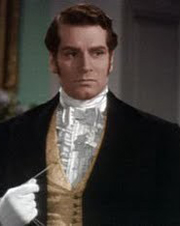
Perhaps, you enjoyed Matthew MacFadyen in the role, and our mothers and grandmothers kept their eyes on Laurence Olivier who moved women in 1940. There were others who made it on film to play the role in various adaptations.  No matter who your mind wanders to as Fitzwilliam, he’s still the arrogant aristocrat we find utterly fascinating.
However, our beloved Darcy does have his flaws. Before Elizabeth finally humbles him and puts him in his place, he really is annoying. The man never smiles. Of course, if you like aristocratic snobs and are one yourself, I’m sure you think he’s well behaved in his treatment of others. Wonderful Jane Austen pens the most powerful scene after Darcy declares his love for Elizabeth. After all, his love is a sacrificial gift in spite of Miss Bennet’s status in life.
“From the very beginning— from the first moment, I may almost say— of my acquaintance with you, your manners, impressing me with the fullest belief of your arrogance, your conceit, and your selfish disdain of the feelings of others, were such as to form the groundwork of disapprobation on which succeeding events have built so immovable a dislike; and I had not known you a month before I felt that you were the last man in the world whom I could ever be prevailed on to marry.” 
Jane Austen’s colorful characters are worth their weight in gold.  Darcy, of course, is just one of the many leading men we can fantasize about in Austen’s works.  Is he my favorite among all of Jane’s creations?  No. Now that I’ve shocked you, you’ll just have to wait and see which man moves my heart or “floats my boat” as Amanda Price would say in Lost in Austen.

Enjoy your daydreams of Darcy; and do tell, who is your favorite!

Feeling most agreeable,
Vicki 

Articles, Colin Firth, Darcy, Elliot Cowan, Fitzwilliam Darcy, Jane Austen, Matthew MacFayden, Pride and Prejudice

Jane Austen’s Leading Men – Fitzwilliam Darcy

Fitzwilliam Darcy.

When he was conceived by Jane Austen and read by women everywhere before movies came along, I wonder how he was pictured in the minds of women. Of course, I’m sure that propriety forbade them to speak openly of such private imaginations. Well, let’s face it, as Jane said, a “lady’s imagination is very rapid” and who knows where it will lead besides matrimony.

As modern women, we are blessed with the advent of movies that have cast Darcy in the bodies of handsome actors. It’s here in our 21st-century world when we read Pride & Prejudice, we no doubt picture one of these men wearing a cravat and looking quite dashing in their period clothing.

I think it’s safe to say that most ladies love Colin Firth as the Darcy of their dreams. My tastes lean toward Elliot Cowan as my swoon-worthy Darcy. (Who you say? He played Darcy in the fictional world of “Lost in Austen.”) There was something about his appearance, characterization, and voice that made me go weak in the knees.

Perhaps, you enjoyed Matthew MacFadyen in the role, and our mothers and grandmothers kept their eyes on Laurence Olivier who moved women in 1940. There were others who made it on film to play the role in various adaptations.  No matter who your mind wanders to as Fitzwilliam, he’s still the arrogant aristocrat we find utterly fascinating.

However, our beloved Darcy does have his flaws. Before Elizabeth finally humbles him and puts him in his place, he really is annoying. The man never smiles. Of course, if you like aristocratic snobs and are one yourself, I’m sure you think he’s well behaved in his treatment of others. Wonderful Jane Austen pens the most powerful scene after Darcy declares his love for Elizabeth, totally undone by the feelings he has tried so hard to repress. After all, his love is a sacrificial gift due to Miss Bennet’s status in life.  Hear him declare: In vain have I struggled. It will not do. My feelings will not be repressed. You must allow me to tell you how ardently I admire and love you.”

But alas, Elizabeth will have none of it, as she puts him in his place.

“From the very beginning— from the first moment, I may almost say— of my acquaintance with you, your manners, impressing me with the fullest belief of your arrogance, your conceit, and your selfish disdain of the feelings of others, were such as to form the groundwork of disapprobation on which succeeding events have built so immovable a dislike; and I had not known you a month before I felt that you were the last man in the world whom I could ever be prevailed on to marry.” 

Jane Austen’s colorful characters are worth their weight in gold.  Darcy, of course, is just one of the many leading men we can fantasize about in Austen’s works.  Is he my favorite among all of Jane’s creations?  No, he isn’t.

Now that I’ve shocked you, you’ll just have to wait and see which man moves my heart or “floats my boat” as Amanda Price would say in Lost in Austen.

Enjoy your daydreams of Darcy, and do tell, who is your favorite!