Articles, Cinderella Movie Disney, Fairytale, Historical Romance, http://schemas.google.com/blogger/2008/kind#post, Patrick Doyle

Cinderella Once a Fairytale Book of Romance – Enjoy the Movie!


Oh to be ten-years-old again — innocent, impressionable, and mesmerized by the idea of meeting my Prince Charming.

Cinderella. How many adaptations can this story have? Apparently, not enough. One of my favorites is “Everafter” with Drew Barrymore, but this Disney version is pretty much a starry-eyed spectacle of beauty that bedazzles the childhood in everyone.

The perfect audience are females young at heart, girls five to twelve, and young teenage ladies. Although this morning on the radio I heard a middle-aged male critic gush over the movie too. Will little boys love it?  Probably not, except perhaps for the mice and cat.

The Cinderella tale is slightly modified and extended, but it does the story absolutely no harm whatsoever. For the first time in a long time I give Disney kudos for putting together a movie with a message that drills down into your soul. It’s the words of Ella’s mother before she dies encouraging her daughter to, “have courage and be kind.” The theme resounds throughout the entire movie and is played out with such precision that the message stays with you.  In an age where kids are bullying one another or being the victims of bullies, it brings a beautiful message of the meaning of courage and kindness and the good that it can bring into your life.

Your wonderful Rose from Downton Abbey, Lilly James, portrays an endearing and kind Cinderella.  Daisy the cook from Downton Abbey, Sophia McShera, plays the stepsister Drizella, accompanied by Holliday Grainger as the other mean sister. Gorgeously attired and mean to the core stepmother is played by Cate Blanchett.

Some of the cutest scenes are the fairy godmother transforming the pumpkin, lizards, mice, and the duck into the carriage, horses, footmen, and driver. Their undoing at the stroke of midnight is an hysterical scene with fantastic special effects. Cinderella is turned into a gorgeous beauty in a blue dress, who twirls around dancing in a fantastic choreographed waltz with the prince. If I were ten, my eyes would probably be bulging out of my head. At sixty-five, I had a huge smile on my face watching the transformation, the ball, and the end of the spell.

All in all, it’s an entertaining movie that is visually stunning. The anchor that holds it all together is the theme of “have courage and be kind” that is said time and time again until you believe it to be truth, witness that good prevails, and realize fairy godmothers do exist.

Oh, and Prince Charming isn’t bad looking either.
Love the soundtrack!
Arsenic, http://schemas.google.com/blogger/2008/kind#post

"Arsenic and Victorian Lace" (Guest Post by Nora Covington)

How do you commit murder? Well, in the Victorian era arsenic was a good way to do in your rivals, spouses, and enemies. My latest release, Blythe Court, contains arsenic, and you may wonder if my use is accurate. Hopefully, you know by now I do my research, even if it really does sound extremely odd when you read the story.

Arsenic, in case you need a quick education, is a chemical element. It occurs in many minerals. During the Victorian era, it was widely used in commercial products. It was also available to purchase in bottle form from a druggist—half an ounce cost a penny, enough to kill 50 people. Unbeknownst to the Victorians, they were slowly poisoning themselves from wallpaper to clothes. The poison caused agonizing deaths until they finally realized the dangers of the chemical and began putting restrictions in place.

Here are a few of the products that contained arsenic:

1. Wallpaper. The Victorians loved the color green. Scheele’s Green was a pigment derived from arsenic. During the 19th century, homes were decorated in wallpaper that emitted toxic fumes causing illness. If a piece of wallpaper flaked off and a child ate it, death arrived.

2. Dresses. Green-colored fabric in dresses and other clothing contained arsenic. “Drop dead gorgeous,” is a term I see in many articles about women wearing clothes filled with arsenic. You looked stunning in green, but your skin absorbed the poison. You swirled around a ballroom, and your dress gave off fumes dangerous to your partner and those around you. Eventually, a test was developed by simply placing a drop of ammonia on the fabric. If it turned blue, arsenic was present.

3. Other clothing and accessories: Socks, hats, gloves, underwear, etc.

4. Toys. Children sucked on toys made with arsenic and became ill or died.

5. Other products. Cookware, wine bottles, face powder, shampoo, and the list goes on and on.

The Victorian home could be a death trap, as well as your wardrobe. As the population became increasingly ill and deaths rose, Parliament still refused to ban the use of arsenic in products because it was a booming business. It wasn’t until the end of the Victorian era that manufacturing of products that contained arsenic was curtailed.

On the other side of the coin, were the accidental poisonings. If you didn’t read the label closely enough, you could pick it up in the kitchen and add it to your food in error. Arsenic looked like other substances such as sugar—powdery white. It wasn’t until 1851 laws were enacted to color the arsenic so the difference could be detected and ladies no longer grabbed the wrong thing thereby killing their entire household from a newly baked pie. Contaminated well water could also contain arsenic.

If you want to get all “Arsenic and Old Lace” about the subject, arsenic could be easily slipped into food and drinks unnoticed because it was tasteless and odorless. Enough could do you in quickly while a little sprinkle here and there could lead you down the road of a slow and agonizing death. Apparently, the greatest users of arsenic in murders cases were Victorian women wanting to do away their husbands. Can’t divorce the drunken abuser who beats you every night? Try arsenic. Here is an interesting article about famous ladies of the day killing off their husbands with this versatile substance.

CLICK HERE

The symptoms of arsenic poisoning over a period of time included white lines forming on your nails, nausea, stomach pain, vomiting, hair loss, muscular weakness, kidney problems, and other not-so-pleasant medical ailments. In spite of the negative symptoms, the Victorians also hailed it as a medical cure for low libido, eczema, and other remedies.

For more information on arsenic poisoning during the Victorian era, here is a good resource:

The Arsenic Century: How Victorian Britain Was Poisoned At Home, Work And Play
by James C Whorton
Articles, http://schemas.google.com/blogger/2008/kind#post

“Arsenic and Victorian Lace” (Guest Post by Nora Covington)

How do you commit murder? Well, in the Victorian era arsenic was a good way to do in your rivals, spouses, and enemies. My latest release, Blythe Court, contains arsenic, and you may wonder if my use is accurate. Hopefully, you know by now I do my research, even if it really does sound extremely odd when you read the story.

Arsenic, in case you need a quick education, is a chemical element. It occurs in many minerals. During the Victorian era, it was widely used in commercial products. It was also available to purchase in bottle form from a druggist—half an ounce cost a penny, enough to kill 50 people. Unbeknownst to the Victorians, they were slowly poisoning themselves from wallpaper to clothes. The poison caused agonizing deaths until they finally realized the dangers of the chemical and began putting restrictions in place.

Here are a few of the products that contained arsenic:

1. Wallpaper. The Victorians loved the color green. Scheele’s Green was a pigment derived from arsenic. During the 19th century, homes were decorated in wallpaper that emitted toxic fumes causing illness. If a piece of wallpaper flaked off and a child ate it, death arrived.
2. Dresses. Green-colored fabric in dresses and other clothing contained arsenic. “Drop dead gorgeous,” is a term I see in many articles about women wearing clothes filled with arsenic. You looked stunning in green, but your skin absorbed the poison. You swirled around a ballroom, and your dress gave off fumes dangerous to your partner and those around you. Eventually, a test was developed by simply placing a drop of ammonia on the fabric. If it turned blue, arsenic was present.
3. Other clothing and accessories: Socks, hats, gloves, underwear, etc.
4. Toys. Children sucked on toys made with arsenic and became ill or died.
5. Other products. Cookware, wine bottles, face powder, shampoo, and the list goes on and on.
The Victorian home could be a death trap, as well as your wardrobe. As the population became increasingly ill and deaths rose, Parliament still refused to ban the use of arsenic in products because it was a booming business. It wasn’t until the end of the Victorian era that manufacturing of products that contained arsenic was curtailed.
On the other side of the coin, were the accidental poisonings. If you didn’t read the label closely enough, you could pick it up in the kitchen and add it to your food in error. Arsenic looked like other substances such as sugar—powdery white. It wasn’t until 1851 laws were enacted to color the arsenic so the difference could be detected and ladies no longer grabbed the wrong thing thereby killing their entire household from a newly baked pie. Contaminated well water could also contain arsenic.

If you want to get all “Arsenic and Old Lace” about the subject, arsenic could be easily slipped into food and drinks unnoticed because it was tasteless and odorless. Enough could do you in quickly while a little sprinkle here and there could lead you down the road of a slow and agonizing death. Apparently, the greatest users of arsenic in murders cases were Victorian women wanting to do away their husbands. Can’t divorce the drunken abuser who beats you every night? Try arsenic. Here is an interesting article about famous ladies of the day killing off their husbands with this versatile substance.

CLICK HERE

The symptoms of arsenic poisoning over a period of time included white lines forming on your nails, nausea, stomach pain, vomiting, hair loss, muscular weakness, kidney problems, and other not-so-pleasant medical ailments. In spite of the negative symptoms, the Victorians also hailed it as a medical cure for low libido, eczema, and other remedies.
For more information on arsenic poisoning during the Victorian era, here is a good resource:
The Arsenic Century: How Victorian Britain Was Poisoned At Home, Work And Play
by James C Whorton
Articles, C.W. Gortner, First Person, http://schemas.google.com/blogger/2008/kind#post, Lost in Austen, Point of View, The Queen's Vow, Third Person

The Power of Point of View

A week ago, I started reading The Queen’s Vow by C. W. Gortner about Isabella of Castille.  If you’re not sure who she is, it’s time to dust off your history books or turn to Google.  In any event, I’m enjoying it immensely and am reminded, as I read the story, about how powerful point of view can be in a novel.  Point of view is that decision an author makes before pounding out 80,000 plus words — through whose eyes shall I tell the tale?


As a reader, you probably have a preference when it comes to your own books.  C. W. Gortner writes The Queen’s Vow in the first person — that is through the eyes of Isabella alone. It’s the “I” and “me” take on life.  I’ve only written one story with this point of view, which happened to be my recent contemporary, Conflicting Hearts.  All of my historical fiction and historical romance novels are written in the third-person limited point of view.  In my books I tend to flip in and out of minds with one person at a time switching in scenes and chapters.  I prefer that take rather than the omniscient view of the all knowing god-type author, which takes a bit of skill I think I lack. Third-person works well in a complex story, because it’s here you can tell the tale from everyone’s point of view.  It makes the story richer in certain circumstances.


As I read The Queen’s Vow, I am reminded that first person can be a powerful tool in a novel. In this instance, the author is writing about the life of Isabella from her childhood to adulthood.  Frankly, I don’t think I’d want someone telling me what she’s thinking, because I’m enjoying too much being inside the head of a young woman destined for greatness. Her thoughts and emotions are richly described, as well as her growth process into the woman she is to become. I don’t think any other point of view would make the book as powerful.


Take the picture up above. It’s a scene from Lost in Austen. There is Darcy, Bingley, and snooty Caroline, his sister standing together. Each are gazing at Amanda Price, and all of them at this moment have a distinct thought about the individual who is central to the story.  In this instance, a writer could say that Darcy frowned disapprovingly narrowing his eyes; Caroline gazed pathetically at Amanda making a fool of herself; and Bingley feels quite perplexed not knowing what to think of this woman visiting the Bennett’s household.


If we crawl into the head of one person, however, let’s say Darcy, we know that something more is brewing inside of him besides the disapproving frown on his face.  He’s going through an inward struggle at this point wondering why he is attracted to a woman who he also despises.  You could write the scene telling your readers what he’s thinking in the third-person point of view, but then you could also crawl into his head, look through his eyes, and exploit his emotions to such an extent it will make a lasting imprint upon your mind as a reader.


Once again, Miss Price has managed to make a spectacle of herself amongst our guests. Her style and mannerisms are so unladylike that I find her disgusting on many levels.  She obviously lacks the genteel character of a demure woman that I seek in a wife. I find her outspoken, boisterous, and brazen behavior a chilling reminder of our difference in class. Even my peers avert her presence as if she is carrying the plague. On the other hand, I struggle with an odd attraction toward her, which I find deeply perplexing.  


What could I possibly find alluring in this creature that I deem so vulgar in speech and conduct?  It cannot be physical attraction, for she is but a plain woman compared to the well-dressed, beautiful ladies that fill this hall.  These carnal inklings cause me to question my sound judgment that I pride. Has she bewitched me?  If I succumb to this demonic temptation, I shall become the laughing stock of society. My status as a respectable aristocrat will come to a ruinous end.

Nevertheless, there she stands. My soul aches with each breath that I take. My heart is laden with heaviness. For at this moment, I earnestly desire to take Miss Price into my arms and silence her wagging tongue with the power of my lips. Surely, it will be a bittersweet taste. Oh wretched woman, what have you done to me? 

Well, we may never know what the wretched woman has done to Mr. Darcy. However, I think you get the drift between the various points of views.  As a reader, do you have a preference?  Do you love the minds of many, or do you prefer the intimate voice of the hero or heroine instead?  I’m beginning to think after I finish my current third-person book, I’ll be back in the first-person mode.


Warm regards,
Vicki

Historical Romance Books, http://schemas.google.com/blogger/2008/kind#post, Jimmy Thomas, Jon Paul Artist, Love Long Ago, Robin Ludwig

Those Abs! That Bodice! That Pose! The Joys of Romance Covers

They say men are stimulated visually.  It’s not what they hear whispered in their ears – it’s what they see with their eyes that moves them toward sex and romance.  For the most part, I do think that men are wired that way.  However, when it comes to reading steamy historical romance novels, women are not only moved by the story, but by the covers that give us a glimpse of the hero and heroine.

The historical romance genre bombards readers with bare-chested, muscular males, who have shirts falling off their backs, toned physiques, and six-pack abs. The heroines are women with unbuttoned or unlaced dresses in the back, overflowing breasts from low necklines, and passionate scenes of kissing in provocative poses.  They set the stage for the forthcoming sexual tension between the characters and build the reader’s anticipation of what is to come between the sheets . . . I mean pages.
The old adage you can’t judge a book by its cover is really only a half truth, because I dare say most books are sold in the romance genre by what is on the cover.  The cover sets the scene, tempts us with what’s inside, and reveals the type of book we’re about to read, or at least it should. 
As an author myself, I always try and pick my covers to relate to one of the scenes in my book.  The cover picture above was designed by my graphic artist, Robin Ludwig for my awarding-winning romance Dark Persuasion.  I purchased the stock photograph of Jimmy Thomas, a well-known and popular model who is now on over 4,000 covers.  The cover above is actually two photographs. The picture I chose of Jimmy and the female model tells a story.  Darkness behind the man who can see; light behind the woman who is blind. When I saw the pose, I envisioned a scene in my book.  Jimmy loved the final cover and was kind enough to showcase it on his website for a while.

Of course, there are many talented cover designers and graphic artists that produce fantastic work in the industry.  Large publishing houses can afford the best artists and highly paid models to grace their covers.  One artist in particular is Jon Paul Studios.  I love the fact that when you hit his website you hear the beautiful song, “Somewhere in Time.”  Check out his gallery and get lost in his works of art that are breathtaking beautiful. He also has a Facebook page where he posts his most recent creations. The cover art to the right is a Jon Paul creation.

Many indie authors and traditional publishers are also turning toward stock photography on sites such as Dreamstime, iStockPhoto, Getty Images, Shutterstock, Fotolio, and many more.  The prices are reasonable and licensing terms are fairly straightforward.  Frankly, I’ve thought for many years that photographers have a goldmine of opportunity if they would focus more on historical era shots with men and women in the fashions of the time.  I’m happy to see an increase of such photographs on the market.
Jimmy Thomas is a model who understands the industry and what authors are looking for in cover choices. He regularly does photo shoots in all eras from Renaissance, Regency, Highlander, Roaring 20’s, and others. However, just purchasing a photograph isn’t the end of the design process.  The real artistry, of course, comes when a picture is chosen and then it’s turned into a cover story that is unique. Authors, however, are wise to learn the rules about license usage rights, model releases, and copyright law when dealing with photography. Better to be safe than sued for damages in a court of law for infringement.

Since Fabio’s earlier days of book cover shots, with his long hair, chiseled face and body, it seems the standard for romance covers hasn’t changed very much.  We now have new models and artists on the scene and the advent of advanced design techniques to tickle our fantasies with background scenes. I have noticed, though, a distinct difference between historical romance and historical fiction covers.  Historical fiction uses less exposed flesh it appears than the historical romance genre, as you can see by the slideshow below.

In any event, a well designed cover does the trick.  It will either entice us to purchase or not. Frankly, I remember the days when I loved to buy novels with beautiful covers and keep them on my bookshelves like works of art.  Now, we enjoy them our our high definition digital readers.  Wherever they meet our eyes, on print or screen, the effect remains the same — you wish you were the heroine in the arms of the hero about to enjoy the fleshly pleasures that await.
Sigh…
Vicki
Articles, Colin Firth, Darcy, Elliot Cowan, Fitzwilliam Darcy, http://schemas.google.com/blogger/2008/kind#post, Jane Austen, Matthew MacFayden, Pride and Prejudice

Jane Austen’s Leading Men – Part I – Fitzwilliam Darcy

Fitzwilliam Darcy. When he was conceived by Jane Austen and read by women everywhere before movies came along, I wonder how he was pictured in the minds of ladies. Of course, I’m sure that propriety forbade them to speak openly of such private imaginations. Well, let’s face it, as Jane said, a “lady’s imagination is very rapid” and who knows where it will lead besides matrimony.
As modern women, we are blessed with the advent of movies that have cast Darcy in the bodies of handsome actors. It’s here in our 21st century world when we read Pride & Prejudice, we’re no doubt picturing one of these men wearing a cravat and looking quite dashing in their period clothing.
I think it’s safe to say that most ladies love Colin Firth as the Darcy of their dreams. My tastes lean toward Elliot Cowan as my swoon-worthy Darcy. (Who you say? He played Darcy in the fictional world of “Lost in Austen.”) There was something about his appearance, characterization, and voice that made we go weak in the knees.
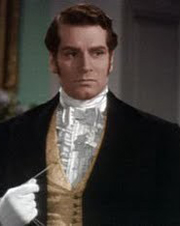
Perhaps, you enjoyed Matthew MacFadyen in the role, and our mothers and grandmothers kept their eyes on Laurence Olivier who moved women in 1940. There were others who made it on film to play the role in various adaptations.  No matter who your mind wanders to as Fitzwilliam, he’s still the arrogant aristocrat we find utterly fascinating.
However, our beloved Darcy does have his flaws. Before Elizabeth finally humbles him and puts him in his place, he really is annoying. The man never smiles. Of course, if you like aristocratic snobs and are one yourself, I’m sure you think he’s well behaved in his treatment of others. Wonderful Jane Austen pens the most powerful scene after Darcy declares his love for Elizabeth. After all, his love is a sacrificial gift in spite of Miss Bennet’s status in life.
“From the very beginning— from the first moment, I may almost say— of my acquaintance with you, your manners, impressing me with the fullest belief of your arrogance, your conceit, and your selfish disdain of the feelings of others, were such as to form the groundwork of disapprobation on which succeeding events have built so immovable a dislike; and I had not known you a month before I felt that you were the last man in the world whom I could ever be prevailed on to marry.” 
Jane Austen’s colorful characters are worth their weight in gold.  Darcy, of course, is just one of the many leading men we can fantasize about in Austen’s works.  Is he my favorite among all of Jane’s creations?  No. Now that I’ve shocked you, you’ll just have to wait and see which man moves my heart or “floats my boat” as Amanda Price would say in Lost in Austen.

Enjoy your daydreams of Darcy; and do tell, who is your favorite!

Feeling most agreeable,
Vicki 

Articles, Divorce Laws 19th Century, Happily Ever After, Historical Romance Novels, http://schemas.google.com/blogger/2008/kind#post, Marriage

And They Lived Happily Ever After

I, take thee, to be my lawful wedded wife, to have and to hold from this day forward, 
for better for worse, for richer for poorer, in sickness and in health, to love and to cherish, till death us do part, according to God’s holy ordinance; and thereto I plight thee my troth.


Sounds like a fairytale, doesn’t it?  Historical romance authors, if they follow the rules, end books in similar ways giving the “HEA” ending to readers.  Who wants to read about divorce in a romance novel?  However, I’m a diehard researcher that always has to look at a situation from every angle, so I took the time to discover the truth about marriage and divorce.

My research regarding divorce laws in France and England reminded me of that phrase we often say, but don’t really adhere to in the 21st century – “until death us do part.”  Let’s move the romance aside for a moment and take a look at the reality of 19th century marriage and divorce.  I discovered the following in my hours of researching the topic from a moral, religious, and civil law perspective.

Marriages in the Victorian era fell into three categories: (1) those contracted for convenience; (2) those produced by sympathy or love; and (3) those entered into from duty. The aristocracy put great importance on the background and nobility of the families they married into, as well as marrying for money. Though love in marriage might be ideal, it was not a practical reality, and people were told not to expect too much from marriage. If you found an ounce of happiness in your union, rejoice.

So what about unhappy marriages? Divorce was not easily obtained. Extramarital sexual relations were a normal feature of life in troubled relationships. After marriage, adultery was almost inevitable. Adultery, believe it or not, was preferred to divorce, mainly because divorce was difficult and expensive to obtain. Men had sex with their wives for children, and bedded their mistresses for love and pleasure. A wife had the duty to obey her husband and produce heirs, and in return for her obedience, the husband owed her protection and security.

Divorce in England and France evolved over the years, coupled with Catholic and Anglican restrictions. A married woman in France needed two causes for divorce – adultery and physical cruelty. Adultery alone was not grounds for divorce for a woman. However, a man could divorce his wife for adultery only.

To file for divorce in France, a petition had to be brought before the president of the chambers, and there had to be two attempts before the court to reconcile the marriage. If the marriage failed to reconcile, then court proceedings would continue. Upon the divorce, the children would go to the custody of the husband.  After 1886, custody was left at the discretion of the court. The wife had to take back her maiden name and was forbidden to keep her husband’s name. The husband could remarry immediately after the divorce became final, but the wife had to wait ten months after the dissolution before she was allowed to marry again.

In Victorian England, the rules were similar. “The husband could obtain a divorce for adultery, the wife could obtain a divorce for adultery coupled with cruelty or desertion for two or more years, and also for incestuous or bigamous adultery, or rape, or unnatural offenses.” (The Encyclopedia Britannica: Volume 3, Google Books)  Divorce could be a lengthy and costly process that only the rich could afford.

Of course, civil laws did not govern church laws.  Catholics could not divorce and remain in good graces with the church, and surely Anglican and other protestant branches held the same views.  Holy matrimony was just that – a holy union not to be broken. The alternative of adultery to divorce was a matter of sin and one’s conscience.  Even though France was predominantly Catholic, the church turned a blind eye to the infidelity of the male Frenchman.

Our modern day divorces are much easier to obtain.  Though we may utter those words “until death do us part,” they don’t really carry the serious consequences of marriages long ago.  Perhaps that is why readers insist on a happily ever after as a perquisite to a good historical romance.  The reality of being chained to a marriage without love for the sake of convenience, law, or religious conscience must have been an unhappy existence.  As Jane Austen would say:

“Happiness in marriage is entirely a matter of chance.

Happily Ever After,
Vicki
19th Century Morality, Articles, Brothels, city of love, http://schemas.google.com/blogger/2008/kind#post

Historical Tidbit on Parisian Morality

Rolla by Henri de Gervex (1852-1929) in the Musee Beaux-Arts, Bordeaux

Uninhibited sexual pleasure in the city of love during the 19th century could cause a 21st century woman’s cheeks to blush.  Prostitution and brothels were at their heyday, and they served a purpose to meet the needs of men both rich and poor. After all, marriage was an institution for producing children; prostitutes and mistresses were for pleasure. The brothel was a place of relaxation for men and accepted as normal practice in society.

How many prostitutes were there during this time period? This may surprise you. Brothels or mansions of tolerance, as they were called, housed 15,000 prostitutes in 1883. Between 1871 through 1903, approximately 155,000 women were registered as prostitutes. Each prostitute had to register at the Bureau of Morals. Afterward, they received a huge laundry list of regulated behavior for their conduct indoors and outdoors. During that time period, 725,000 were arrested by the police for suspected prostitution because they never registered.

Jobs were scare for women and survival of the poor difficult. Even married women participated in prostitution. There were roughly 125 brothels in business during 1870’s.  Brothels were considered a cleaner and more regulated system of pleasure keeping individuals from sexual perversion by giving them an alternative to the women on the streets. Pleasures for the male population were rampant on every corner, and like any other morally questionable practice, it carried consequences.

We tend to romanticize all this into lovemaking in romance novels without consequences, except perhaps a baby or two out of wedlock. Unfortunately, all those pleasures carried risks, especially contracting syphilis. How many had the disease? You might wish to sit down. Fourteen to fifteen percent of deaths were attributed sexually transmitted disease. Some reports carry it as high as 17%. One-tenth of the population contracted syphilis. You may think that’s not many, but one-tenth of the population equated to four million people. Syphilis was attributed to 40,000 still births yearly,when gone untreated, progressed into a dastardly end. Half of the cases were contracted between the age of 14 and 21. As one report put it, young people could not wait to dispel of their chastity.

Treatment for syphilis was inadequate and understanding by the medical community of the disease somewhat lacking. There were hospitals and clinics set up to specifically treat the disease, but many found it embarrassing to seek treatment. Effective treatment really didn’t arrive until approximately 1910 with the onset of better antibiotics. Earlier, Mercury and Potassium Iodide were used.

Nowadays, we’re probably a bit more sophisticated when it comes to sex and disease. After all, we’ve evolved, right? Men that sweep us off our feet today are usually wearing blue jeans and sneakers, and we can insist on blood tests before we hop in bed with them. I guess social progression does have its trade offs, but I have a sneaking suspicion with the number of historical romances sold each year women would rather fantasize in another century with handsome, well-dressed rich men.

Contributed by Vicki Hopkins 4/29/13

Thanks,
Vicki